ORIGINAL FICTION · PSYCHOLOGICAL SUSPENSE
The night-shift window
Three warehouse flashes and a reconstructed dispatch sheet confront Tess with an error she has kept out of the record.
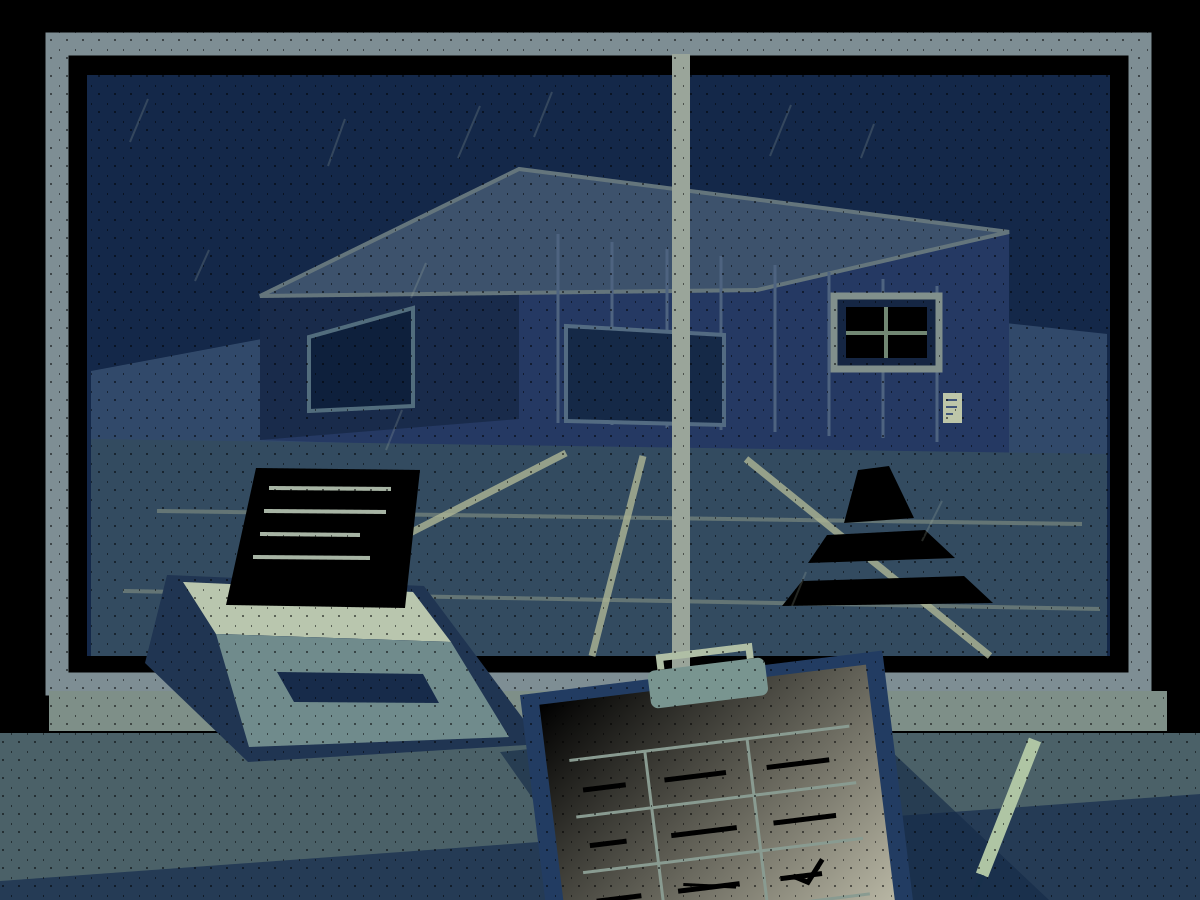
The light came on while Tess was holding a pen above the signature box.
Across the yard, beyond the navy lines of the loading bays, one window in the unused north warehouse turned a hard lime green. The wet concrete caught the color for a moment. Then the window went dark.
Tess looked at the office clock. 2:16:40.
On the previous two shifts she had written down 2:16:06 and 2:16:23. All three flashes had fallen in the same minute. She had watched for the third one with the dispatch sheet in front of her, though she would not have admitted that to anyone who came through the door.
The office air was dry enough to make the paper catch at her fingertips. A fresh copy of the sheet lay above the printer, warming in the exhaust. Her right sleeve, polished along the forearm from years of rubbing the desk edge, dragged softly across its bottom line.
Reconstructed movement, September 17. Eight crates of cafeteria trays, order 5821. Transfer from sorting to south staging, 1:42 a.m. Last handler: Imani Vale. Dispatcher review: T.K.
Tess had entered T.K. beside a location change that night, three weeks ago. It was the only reason she recognized the date before the order number.
Len pushed open the office door with his elbow, carrying a paper cup and his phone. He supervised the night crews, but he still walked quickly when a truck was due, as if he might catch it before it needed anything.
“You found the box,” he said.
“I found it.”
“Inventory wants the missing movements settled before Friday. Sign that and I can send the batch.”
She kept the pen above the page. “Who put Imani on it?”
“She scanned the crates out of sorting.”
“Out of sorting isn’t into south staging.”
Len took a sip, then looked at the sheet. “The destination was south staging.”
“It is now.”
He lowered the cup. For a second she thought he had heard everything she had not said. Then a truck radio crackled on his phone, and he glanced at the screen.
“This is a reconstruction, Tess. The arrival scanner didn’t record them. We use what we have.”
The phone crackled again. He stepped into the corridor to answer it, telling her to leave the signed copy on his desk.
Tess laid down the pen.
Imani’s chipped cup stood on the shelf above the radio. Tess had moved it there in July, when she came back from the wrist injury. For six weeks Imani had worked the desk beside her, answering the calls Tess could not write down quickly enough. At four they used to divide a sandwich and pour tea from Imani’s flask. On Tess’s first full shift back, Imani had pulled up the second chair. Tess told her she had the desk under control. There had been no quarrel. Imani took the chair away, and Tess put the cup on the shelf to clear space for the printer labels.
During those six weeks, Tess had sometimes let the phone ring until Imani reached it. She remembered the relief of hearing Imani answer and had wanted that feeling gone when her wrist healed. Imani still knew which calls made her stop writing. She would have known to ask why Tess was frightened of the light.
From the office, the north warehouse looked sealed. Its doors had been chained since a roof leak closed the building, and the yard lights did little inside its windows. The first time she saw the green flash, she had been reading Len’s notice about the inventory review. On the second night, someone from the day shift had called to ask whether she remembered an old change of destination. She had said she would look. After that, she had begun watching the window.
There was a sensible way to settle a light in an empty building: ask maintenance. She had not done it. Instead she had kept three times on the back of a truck appointment card and checked the window without turning her head when anyone else was in the office.
She opened the bottom desk drawer.
The September 17 papers were beneath a stack of rejected labels, where she had put them after changing the screen. On that night, rain had come through the loading canopy in sheets. Two trailers had traded bays, a driver had arrived early, and Imani had asked for a place to put order 5821 while the south staging lane cleared.
Tess had meant to send the trays to S3. She had typed N3.
N3 was inside the north warehouse. When she saw the mistake on the screen, the move instruction had already printed and Imani had already collected it. Tess changed the destination to S3. The system saved the revision under T.K. She told herself she would call Imani as soon as the next driver had his papers.
By the time the driver left, Imani’s forklift was back at sorting. Tess had watched her pass the office without calling her in. Calling Imani back would have meant finding someone to cover dispatch while Tess checked the building herself. The next morning, the screen still said S3. Tess left it there.
Now she pulled out the original move slip. The paper had a tire-dark thumbprint at one corner. N3 was printed plainly beneath the order number. Imani had written placed inside north door beside her initials.
Tess read it twice. She had seen the note weeks ago. She had folded the slip with that side inward.
There were eight crate numbers on it, copied by hand from the labels: 61420, 61421, 61423, 61424, 61431, 61432, 61434, 61435.
Len’s sheet listed 61420 through 61427.
He had filled the gap with a sequence. Four numbers on his sheet did not belong to the shipment at all.
Tess set the two pages next to each other. The printer clicked as it cooled.
Imani came in at 2:30 for the keys to a waiting trailer. She stopped when she saw the old slip on Tess’s desk.
“That’s the trays,” she said. “Did they finally find them?”
“No.”
Imani picked up the slip. Her finger rested on the note beside her initials. “I told the day crew I put them inside north. They said the screen showed south.”
“Who said that?”
“You were copied on the message.”
Tess had read it during a crowded handoff. She remembered replying that the current location was S3, a fact she could take directly from the screen she had changed.
“I changed the screen.”
“I know someone changed it. I asked who.”
“I sent you there,” she said. “It was my entry. I found it afterward and changed it without checking where you’d put them.”
Imani laid the slip flat on the desk. She smoothed its old fold with her thumb.
“When did you get this back?”
“That morning.”
“With my note.”
“Yes.”
Imani went to the shelf and took down her cup. She turned it over to shake out the paper clips Tess had put inside.
“They had me walking the south lanes after my shift. Twice. I told them I hadn’t put the trays there.”
“I didn’t know they’d kept you.”
“I asked you to tell them.”
The clips lay scattered beneath the radio. Tess picked one up, bent it between her fingers, then put it back.
Imani looked from Tess to Len’s reconstructed sheet. “And he wants you to sign this?”
“Yes.”
“Have you?”
“No.”
Outside, a reversing alarm sounded twice and stopped. Imani wrapped the cup in a spare glove and put it into her bag.
“I need to check the north building,” Tess said. “Can you cover the desk for twenty minutes?”
Imani looked at the clock. Her shift ended at four. At the beginning of the night she had reminded Tess about the 4:08 bus, which left from the gate at the far end of the yard.
“No. Get someone else for the desk. I’m coming to see the crates.”
“Len can give us the key.”
“Ask him for the cover too.”
Tess took the receiver off its cradle. While it rang, she looked at the shelf above the radio. A pale circle showed where the cup had stood.
Len came in before the call connected. Tess replaced the receiver and showed him the slip and the two lists of crate numbers. He held his reconstructed page against the original, lining up the order numbers as though the rest might line up too.
“Why wasn’t this filed?” he asked.
“I kept it.”
“Why?”
“I changed the destination after I printed it. I didn’t check the move. I didn’t report the error.”
Len looked at Imani. “Did you leave all eight inside?”
“All eight on that slip. I can’t tell you anything about the four you wrote down.”
He turned the reconstructed sheet face down. “I used the first number and the quantity.”
“Then it’s a guess,” Tess said.
“It says reconstructed at the top.”
“It says Imani delivered them to south staging, and the signature box says I verified it.”
Len rubbed a crease into the side of his cup. He did not defend the box.
“I need you to arrange cover,” Tess said. “Imani isn’t staying at the desk.”
“She knows the calls.”
“She’s going with us.”
Len glanced at Imani, who had put her bag by the door. He called cross-dock. A relief clerk arrived with his coat half on, and Tess handed him the truck appointments. She began explaining a driver’s habit of calling from the wrong bay.
“I’ve had him before,” the clerk said.
She let go of the receiver. Len fetched the north key from the guard.
They crossed the yard together. The rain had stopped, but water held the sodium light in broad orange patches under their shoes. Tess carried the old move slip in a clear sleeve. Len carried a flashlight. Imani walked ahead of them toward the north door, taking the route a forklift would have taken from sorting.
At the door, the guard broke a paper seal, worked the stiff lock and released the chain. The air inside smelled of damp cardboard and floor dust. Their footsteps sounded too loud in a building that had held neither workers nor trucks for weeks.
Imani pointed along the beam of Len’s flashlight. “I left them along that wall, clear of the door. Someone’s moved things in front.”
A low maintenance device stood beneath the window, its cord running to a covered outlet. A green lens faced the yard. A tag hung from its handle.
Tess stepped close enough to read it. Moisture check, north warehouse. Automatic nightly cycle. Installed September 19. Do not remove before October 10. Beneath the dates were the maintenance worker’s initials and a phone extension.
The three times on Tess’s card were seventeen seconds apart. Len called the extension on the tag. The maintenance worker confirmed that the indicator flashed at the start of the nightly cycle; its timer was drifting late. No one came over to run it. The timer had supplied all three flashes.
Tess folded the card and put it away. Imani called from behind the barriers. “Here.”
Behind them stood eight wooden crates under a loose plastic cover. She lifted one edge. The label on the nearest crate read 61420. Tess checked each number against the slip while Imani shifted the cover. The last was 61435. Inside the cracked corner of one crate, a stack of gray cafeteria trays showed through its packing.
Len took photographs of the labels. A handling note on the wall said maintenance had moved the barriers while working near the window. Imani crouched to tug the cover out from beneath the last crate. Her glove caught on a splinter.
Tess bent to hold the plastic loose. Imani freed her glove and stood. The long strip of wood it had pulled up remained attached to the crate.
“I had a copy of the slip,” Imani said. “I left it for the day crew. They said it was old.”
Tess still held the plastic. It crackled when she loosened her hand.
“You should have kept a copy for yourself,” she began.
Imani looked at her.
“You shouldn’t have needed one,” Tess said.
Len lowered his phone. “We’ll put it right.”
“Before I leave,” Imani said. She pulled off the snagged glove and put it in her coat pocket.
“Can they go out on tomorrow’s truck?” Len asked.
“Once the order is put back on the schedule,” Imani said. “I’m not moving them on a sheet that says they’re in south.”
Len nodded. “We’ll make the record first.”
From where Tess stood, the office window was a small pale rectangle beyond the open north door. The relief clerk leaned across its desk to answer the phone. She could hear the faint bell through the yard. She left her hand off the radio at her belt.
Imani stayed in the office while Tess gave Len the account. He wrote that she had changed N3 to S3 before checking the move. Tess stopped him before he closed the incident form.
“I read her note that morning. I knew where she’d put them.”
Len took his fingers off the keyboard. The relief clerk was still answering calls at the other end of the desk. Tess spoke loudly enough for him to hear.
“And when the day crew asked, I repeated the screen location. I had this paper in my drawer.”
Len added it. On the movement record he restored the eight actual crate numbers and the north location, retaining Tess’s earlier revision. He marked his reconstructed sheet unsupported. Tess signed the correction and the account of her concealment. Imani read them, asked for copies, and slid those into her bag beside the wrapped cup.
“I’ll tell the day crew,” Tess said.
“Len can tell them.”
Len nodded. He would call before Imani’s next shift. She watched him write the reminder on his handoff card.
Tess could still have asked whether they were all right. Imani was checking that the pages in her bag lay flat. Tess found the question in her mouth and held it there.
“The searches after four,” she said. “You should be paid for that time.”
“I put the hours in. They took them off when nobody could confirm I’d stayed.”
Tess looked at Len. “I was here. I can confirm them.”
“You saw me leave the lane both mornings,” Imani said.
“I did.”
Len asked her to give him the dates. Imani told him without reaching for her phone. Tess remembered her passing the window with her bag while the office clock showed well past four. Once she had lifted a hand; Tess had looked back at the screen.
After Len left, Imani stood at the second chair.
“I won’t fill in at this desk for a while,” she said. “If you need a break, call him. Don’t keep asking me whether I’m sure.”
“I’m sure you mean it.”
“Then don’t ask.”
Tess nodded. Imani went out to finish her shift. Her cup had left a ring of dust among the printer labels. Tess wiped the shelf with the corner of a damp cloth. She did not put anything into the circle.
At 3:52 Tess called Len. A refrigerated truck was running late; its driver had called twice, and the next call could come at any moment.
“I need twenty-five minutes,” she said.
“Now?”
She watched Imani wheel an empty cart across the bay. “Now.”
Len came in and picked up the receiver as it rang. Tess gave him the late truck’s number. For future destination changes, they agreed she would call him for coverage and leave the desk to check the physical move. He repeated it while he pulled the chair toward him. Tess went out without waiting for the driver to call.
Imani was putting on her coat by the lockers. A thread from the torn glove hung from her pocket. Tess held up the other glove, which had fallen behind the office door.
“This one was on the floor.”
Imani took it. “Thanks.”
“Can I walk to the gate with you?”
“I’m not having another conversation about it on the way.”
“All right.”
They crossed the yard. A cart rattled over a drain behind them; Tess slowed, then caught up. Len could deal with whoever wanted the desk. The soles of Imani’s boots made a small sucking sound where the water lay thickest. At the north warehouse, the timer’s window was dark. Imani walked past it without looking.
The bus turned into the service road as they reached the gate. Tess opened it and held it while Imani stepped through. A broad puddle lay between the gate and the curb. Imani took the narrow dry edge, holding her bag away from the wet fence.
From Tess’s belt, the radio clicked. She put her hand over it before the sound could carry.
Imani stopped at the bus door. “You’re on break?”
“Len has the desk.”
Imani nodded once and climbed aboard. Through the glass Tess saw her unwrap the cup to make room for the papers. She tucked the loose glove beside it, then pulled the bag shut.
The bus moved off. Tess stayed outside the gate until its rear lights passed the bend. She had six minutes left. Across the road, rainwater dripped from the edge of the shelter onto an empty bench. She went over and sat, keeping her feet clear of the puddle beneath it.
KEEP READING
Another story.
ORIGINAL FICTIONPsychological Suspense
The copy with my notes
A marked manuscript makes translator Ada suspect that her former mentor has taken confidential pages. Carbon sheets and an old joint draft explain the handwriting, but both the breach and Ada's uncredited reuse must be recorded before the commission can proceed.
ORIGINAL FICTIONPsychological Suspense
The courtyard list
Building secretary Priya finds a list behind the courtyard noticeboard and fears a challenge to her position. Her attempt to investigate harms a neighbor, while the true purpose of the appointments brings a withheld complaint back into view.