ORIGINAL FICTION · PSYCHOLOGICAL SUSPENSE
The copy with my notes
Ada's confidential translation arrives covered in her own unfamiliar handwriting, carrying a claim from work she hoped to leave uncredited.
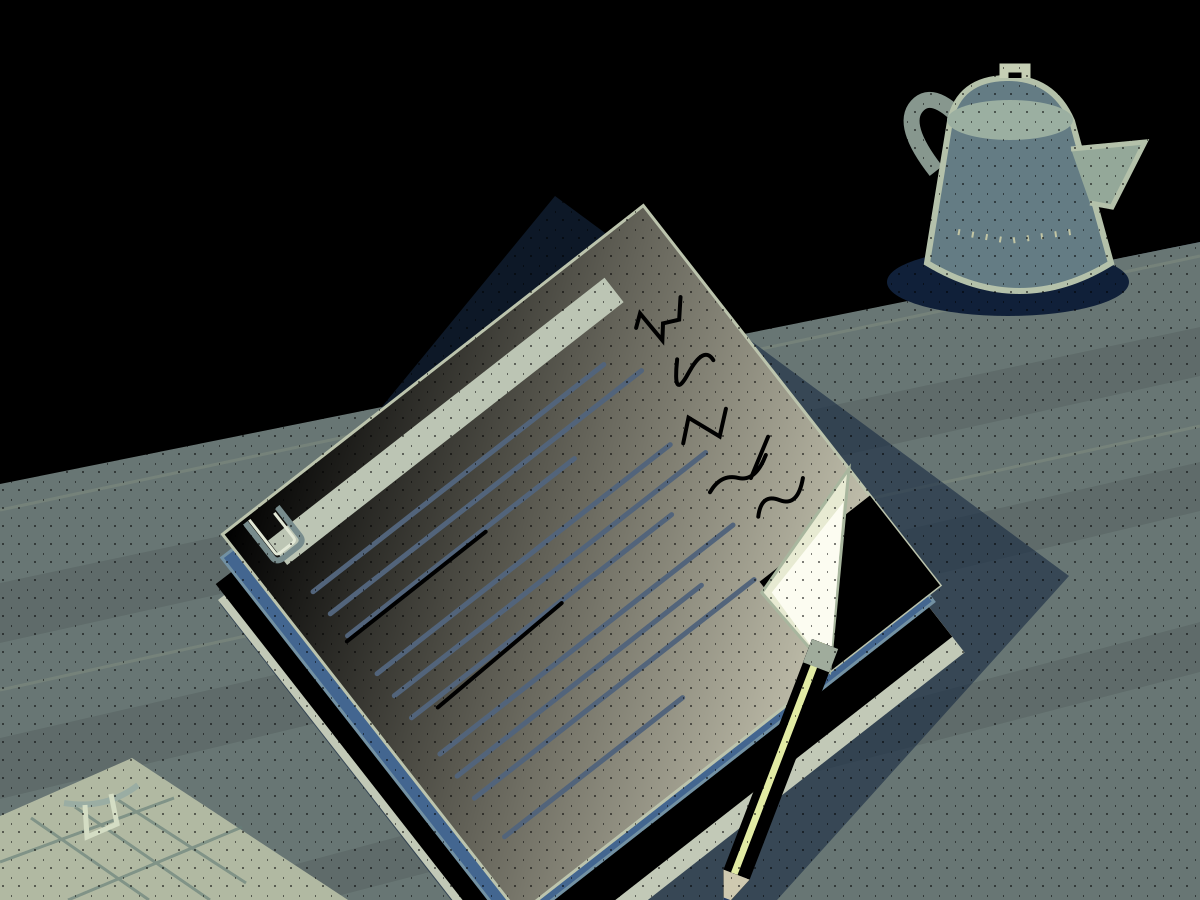
The kettle clicked off while I was cutting open the envelope. I had left it to boil twice already, and the white scale inside was lifting in flakes. A third boil would have done nothing for the tea. I made one anyway.
The envelope held forty-six pages from my translation of The House of Reeds. They were clipped into a navy folder I had never seen. Across page seven, in blue, someone had written, “Do not let him open it twice.”
I put the page down. Then I picked it up by the edge and held it under the kitchen light.
The note was in my handwriting. The capital D leaned forward; the crossbar of the t sat too high. I had made the same irritating marks on shopping lists and on my first passport application. I had not written this note. I was certain of that until I turned the page and found another.
“Keep the window sweating.”
A rubbed patch of graphite darkened my palm. I went to the sink, stopped, and looked at the folder instead. The manuscript was confidential. Highwater Editions had sent it to me under an agreement that named the people permitted to see it, which did not include whoever had assembled this package. The book was to lead their new translation series. My contract, and most of next year’s rent, depended on their keeping me on it.
The first page bore no letter. On page forty-two, someone had bracketed a paragraph and written, “You already chose this.”
I knew those words. I had written them nine years ago, when Gideon Marr and I prepared a sample from an earlier version of the same novel. We had spent a whole afternoon on that paragraph. Gideon wanted the woman to leave the cup beside the window; I wanted her to carry it back to the table. He said she could not do both. I wrote “You already chose this” beside my second attempt, chiefly to make him stop asking.
I was alone on the Highwater contract. Gideon had asked about it when the announcement appeared. I told him the novel had changed too much for the sample to be useful.
The kettle cooled behind me. I laid the old translation, as much of it as I could remember, against the paragraph on page forty-two. I had changed a verb and removed a sentence. The rest was ours.
I called Highwater. At eight in the evening, the office number went to a recording that sounded pleased with itself. I left no message. I put the pages back in their folder and slid the envelope beneath a stack of dictionaries. An hour later I took it out again. I wanted to see whether the blue writing came off on my fingers. It did not.
At Highwater the next morning, I asked for Nessa Kwan, the editor of the series. Her assistant, Ben, was passing through reception with a cardboard tray of coffees. He saw the navy folder in my hands and stopped so suddenly one lid jumped loose.
“Where did you get that?” he asked.
“It came to my door.”
He set the tray on the floor to close the lid. “I printed those for a reader.”
“Which reader?”
He looked toward Nessa’s office. “She should tell you.”
Nessa made room on her desk by moving a heap of catalog proofs onto a chair. She examined the envelope, then the first marked page. I watched her face for recognition. She took longer over the blue note than over my name on the cover.
“Gideon Marr,” she said at last. “I asked him to look at the opening.”
“He wasn’t on the circulation list.”
“No. That was my decision. He’d worked with Senn’s writing before, and I wanted his view on whether the opening held up in English.”
“He’d worked on this writing before.”
Nessa looked up. “You said he’d consulted on an old proposal. You didn’t say any of that prose was still in the draft.”
I kept my finger on the circulation list. Nessa waited for me to answer about the paragraph.
Ben knocked and came in with one of the coffees. The edge of a staple on Nessa’s desk caught his sweater cuff as he reached across. He pulled gently, waited while she freed the thread, and left without looking at me.
“I asked for a reading here,” Nessa said. “I did not authorize him to take the pages away or contact you.”
I turned to the last sheet. My address was on the envelope in block letters. There was no return address.
“I’ll need that in writing.”
“You’ll have it. I need something from you too.” She tapped page forty-two. “How much of this was joint work?”
“I need to check the old draft.”
“I know that is your answer today.”
I looked down at page forty-two. Nessa put the marked copy into a clear folder and gave it back.
“Don’t make any more marks on these,” she said. “I’m stopping the book meeting until we sort it out.”
The meeting had been scheduled for Friday. A delay would reach the sales team before it reached anyone willing to call it a delay.
Outside, I looked at the address on the envelope. Gideon had spelled out Apartment where I always abbreviated it. The ink on the envelope had not rubbed off where the rain had spotted it.
Gideon lived above a shop that repaired lamps. The stairwell smelled of hot dust. I had climbed it often enough, years ago, to know which step gave under a heel. I still avoided it.
He opened the door with a pencil in his hand. When he saw the folder, he stepped back.
“Did you think I wouldn’t know it was you?” I asked.
“I hoped you’d know exactly.”
His workroom had shrunk since my last visit. Books occupied the space where a second chair used to stand. On the table lay a ruled notebook with a torn blue sheet showing beneath its cover. I noticed it before he moved a stack of mail over it.
“You sent me pages you were supposed to read at Highwater,” I said.
“Yes.”
“Did Nessa know you took them?”
“No.”
“Did you tell her you’d sent them to my home?”
“No.” He set down the pencil. “Did you tell her about the sample?”
I pulled out page forty-two. He made no move to take it.
“I told her I needed to check it.”
“You’ve had nine years.”
“Some of us don’t keep every scrap of paper within reach.”
“I kept the work.”
He lifted the mail from the notebook. It was one of the cheap carbon books we had used when we drafted together, thin blue sheets alternating with white. We had bought two at a stationery shop after Gideon accused my laptop of losing the history of every sentence. I had called the books a method for producing two illegible copies instead of one legible one.
He opened it to a page whose upper right corner was gone. There was the old sample, typed and pasted in strips onto the ruled paper. In the margin, in pencil, I had written, “Do not let him open it twice.”
I could remember the argument now. The man opened the door once in the scene, left it ajar, then returned and pushed it wider. Gideon had wanted two deliberate openings. I had wanted the second movement to frighten the woman because she had forgotten the door was ajar.
A few lines lower: “Keep the window sweating.”
The phrase had been about condensation. On the copy at my house it had looked like a warning.
“Why copy these notes onto my current pages?” I asked.
“Because you would recognize them.”
“I didn’t.”
He drew the notebook toward him. “You did eventually.”
The corner was missing where a staple had once held loose sample pages to the notebook. A gray thread of cloth clung to the bent metal. Gideon saw me looking and folded the page back.
“Show me how you did it.”
He looked offended. “You think I found someone to write like you?”
“I think you had some help from stationery.”
He took out a sheet of thin blue carbon and placed it on the table. Then he laid a clean page from his own printer beneath it and the old marked sheet above it. He lined up the left edge of the pasted text with a faint vertical mark on the clean page, then followed one of my old pencil notes with his blunt pencil. The blue carbon lay between the old sheet and the new one.
“The layout is almost the same,” he said. “I had to shift the later pages a little.”
I looked down at the old sample. I had built my current chapter in the old file so that I could compare it with the revised source. I had kept the margins and line spacing. On page forty-two, I had kept much more.
Gideon ran the pencil along the torn corner as an alignment mark, then lifted the top sheet. The same shallow diagonal impression marked the modern page in my folder. I could feel it with a fingernail. Beneath the paper clip, a small blue crescent matched the edge of the carbon sheet. He had retraced my pencil notes through the old page, pressing them onto the new one. On the clean page, the t had my high crossbar.
“The graphite on page one?” I asked.
“I marked where to line it up. I should have erased it.”
“You should have left the pages at Highwater.”
“Yes.”
I had prepared several more sentences. I left them unsaid.
“Why didn’t you write to me?”
“I did. In June. I asked if any of our sample had survived into the commission.”
“I answered.”
“You said you were translating the revised text.”
“I am.”
“You are. And you used this.” He turned to the paragraph he had bracketed. “I don’t want your whole book. I want my work named where it appears.”
“Then you could have said that to Nessa.”
“After I saw the pages. I should have. I wanted you to say it first.”
He sat down, leaving me beside the table. I could have taken the old notebook and compared every line. I could also have asked whether he had kept a copy of the current manuscript. Both questions mattered. The second was easier.
“Did you copy the pages before you returned them?”
“No. Nessa printed the file at Highwater. It never came to me.”
“She said you were to read it there.”
“I took the paper. I didn’t take their machine.”
He reached under the notebook and brought out three loose current pages.
“I missed these when I put the folder together.”
I took them by their clean margins. He had made a little diagonal pencil mark at the top of one. Behind it sat another passage we had worked on together, though I had replaced nearly all its sentences. I was relieved to see the changes. Gideon watched me reading, and the relief became embarrassing.
“How much credit do you want?” I asked.
“For the sample that’s in the book.”
“That isn’t a credit line.”
“It could be if you and Nessa stopped treating it as a difficulty in the schedule.”
He carried the notebook to the doorway and opened it to the bracketed paragraph once more. As I reached past him for the door, the old staple caught my sleeve. I held still while he worked the fabric free with the point of his pencil.
On the stairwell I checked the three pages again. A faint blue impression showed through the back of the last one. I carried them flat all the way home.
I had the joint draft in a box above my kitchen cabinets. Gideon’s carbon notebook had made two copies, but I had kept more than my share of the loose pages. Mine still bore a pale rectangle where a glass had stood during that afternoon’s argument. I remembered accusing him of putting it on the paper. It had been my glass.
I spread the old pages beside the current chapter. Some matches were slight: a noun, a line break, a solution we might each have reached separately. Others were the sentences we had moved together from one draft to the next. I marked those on a separate sheet. The disputed paragraph was not the only one.
Nessa had emailed an account of the handling while I was at Gideon’s. It named the pages she had given him, the office reading she had expected, and the first she had heard of their delivery to me. She had copied her managing editor. I wrote back with what Gideon had admitted and said I held three further pages he had returned in person.
Then I opened the contract letter on my screen. My name stood alone after Translated by. I selected the line and sat looking at the blank space it left.
I sent Nessa scans of both drafts and a list of the passages I believed we had made jointly. I included the pages where I had translated afresh, because I wanted the boundary to be accurate. In the same message I asked her to preserve the marked copy and the account of its circulation. I did not ask her to keep the Friday meeting.
She called the next morning.
“We have to pull this version,” she said.
“I expected that.”
“The series committee can look at the credit next week. I’m proposing that you finish the remaining translation and that the joint material be credited separately. Your fee will be adjusted. I can’t promise the original publication slot.”
I wrote down the last sentence, though I would remember it.
“What does Gideon want?”
“He asked for both names on the title page. I told him we’d first establish what he worked on.”
“That will annoy him.”
“Yes,” Nessa said. “He was fairly clear about it.”
Two weeks later, I went to Highwater to sign the amendment. The book meeting had moved to a date Nessa could not yet give me. On her desk sat a fresh manuscript with the disputed chapter removed. I had turned in a new translation of its revised passages, leaving out the sentences Gideon and I had made together. Nessa had placed the old sample in a separate packet for the publisher to consider with both our names attached.
The amendment gave me the remaining translation. An attached credit page read: “The earlier translation of the selected passages in Chapter Four was prepared jointly by Ada Sloane and Gideon Marr.” It listed the passages by their positions in the old and current drafts. Gideon had signed beneath it the day before. His signature pressed hard enough to show through the page.
Nessa handed me my copy. “I’ll let you know when the committee has decided whether to use the joint passages or your new version.”
I put the amendment into my bag. On the fresh manuscript, page forty-two began with a sentence I had written the previous Sunday. There were no marks in its margin. I closed the cover so the loose credit packet would not slide out when Nessa carried it upstairs.
KEEP READING
Another story.
ORIGINAL FICTIONPsychological Suspense
The courtyard list
Building secretary Priya finds a list behind the courtyard noticeboard and fears a challenge to her position. Her attempt to investigate harms a neighbor, while the true purpose of the appointments brings a withheld complaint back into view.
ORIGINAL FICTIONPsychological Suspense
The night-shift window
Night dispatcher Tess fears a watcher's signal while her supervisor asks her to verify a guessed shipment record. Finding the crates will require the colleague whose truthful account she let others disbelieve, and whose help she accepted during an injury and dismissed once she recovered.